Thursday, September 11, 2014

Cross Over Magical Duels

I've been re reading a lot of books about kids mastering the art of Magic. Which inevitably leads to wondering, in a "friendly" duel, who would win. So our starting Competitors are Harry Potter. Valkyrie Cain of Skulduggery Pleasant and Nita Callaghan of the Young Wizards.

Valkyrie vs Harry

We see both of these characters at about 12, and follow them until they finish high school. Right At the beginning, Harry has an edge as his magic sort of works even when he dosn't want it too. But their relative expirecne thereafter rapidly shift the edge towards Valkyrie. While Harry is at school, fighting Voldemort once a year, Valkyrie is going up against tougher and tougher opponents, taking down Gods even, and getting regular high impact combat training. 

So even though Harry's magic is potentially more flexible, its also limited in that Harry needs a wand. While Valkyrie can use most of her Powers without any items. So Harry loosing his wand, makes him near helpless. Valkyrie loosing her necromancer's ring, leaves her with elemental powers and hand to hand combat training, and bullet proof clothing.  So anywhere after the second or third book, she is going to win.

Nita 

Young wizards Happens on a different scale. While Valkyrie basically protect Ireland, though occasionally against cosmic threats, and Harry never leaves England, fighting the same villain for the duration, Nita travels the Universe. Teleporting to Mars is no big deal, she has a shortcut spell for it on her charm bracelet. Time wise a lot more happens to her in a much shorter time span. So by the end of Nine books she is about 15.  

While her magic is a little bit slower then that used by Harry and Valkyrie, it is way more flexible, and powerful. And while the other two systems work outside science, Nita's underpins science, and boarders on total control of reality. So assuming she has enough time for a protection spell, which again she has a shortcut for, she is going to be proof against anything either Harry or Valkyrie could throw at her. Note Nita's force field can resist a supernova at close proximity. Once her sheild is up she has all the time she needs to do whatever. 

And importantly she actually understands her magic. And at 15 is inventing her own spells rather than just doing whats written in the manual. Indeed developing new spells is part of her job. And at 15 she has already come up with one that got  named after her. Callahan's Unfavorable Instigation, a spell for disestablishing fusion reactions. 

I'd note that when Nita has her one on one duel, its against a planet, or at least against someone in full control of one. And she wins it without access to any super weapons. Unlike Harry who had the deathly Hollows, and Valkyrie who had the scepter of the ancients.

The one thing working against Nita is that in her universe, as a rule, wizards get less powerful as they get older. However on the other hand they get better at using the power they do have. And there also apear to be clear exceptions to this rule. The exceptions seem to run on the idea that you get whatever power you need to get your job done. In particular the Planetary seem to have way more power then other wizards their age. And Nita does look like she is heading in the direction of being Earth's Planetary at some point in the future.  Granted, due to the open nature of the series, this is far from certain.

So Nita would beat Valkyrie, who would beat Harry.  


Sunday, August 31, 2014

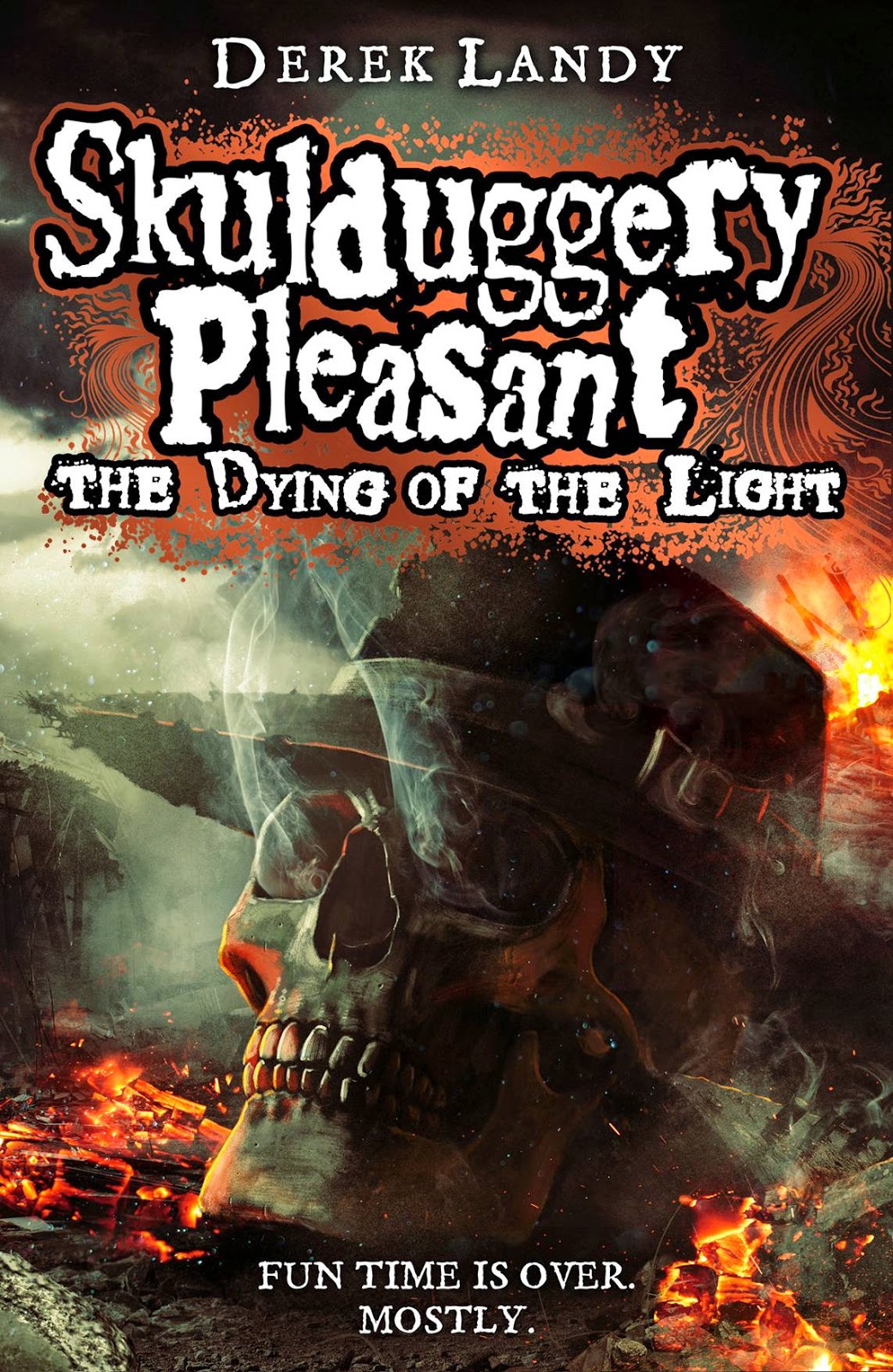
The Dying of the Light

WARNING Spoilers Ahead.

If you are still here you have been Warned. I was really looking forward to this story. And now that I read it I feel, let down. Don't get me wrong, I enjoyed the ride. The banter between Valkyrie and Skulduggery was as good as ever, the action just as good, and the plot at about normal levels of convoluted complexity. But what ruined it for me was the Ultimate Fate of the characters.

Valkyrie

First the whole Meek Ridge plot line Just annoyed me. Yea I get the point of it. The point was supposed to be that the reader does not know which of the Three possible characters this actually is. But the problem is that There never was a doubt in my mind about who this is. I had no doubt that Darquess would loose. And the whole point of the reflection was that she wanted a normal life. So this had to be Valkyrie.

What is more that once we got to the end I felt that her decision to go into self imposed exile was not justified and what is more we didn't See her make it. Indeed we didn't actually get to see how the final climactic scene played out, nor what the aftermath was actually like.  Instead we got a summary told by Valkyrie five years later. As she is about to rejoin Skulduggery, ready for a new adventure.

Worst yet we are teased with her new powers, which she barely gets a chance to use. All in all it makes me want to know how is she going to grow up and finally get out from under Skulduggery's shadow. Especially as her actions here end up being no more than something to distract Darquess with while someone else executes the real plan. This all adds up to her remaining stuck in Skulduggery's shadow, the girl who wasn't strong enough, who's big decision turned out to be futile and pointless sacrifice. The one who couldn't triumph over her own dark side. This is not where I wanted to Leave Valkyrie!

The Reflection

OK, I actually liked her story line. We got to see things from her point of view enough that it actually hurt when she got killed in such a nasty way. It was brutal but effective. She learned to be human, and then had it snatched away from her. Tragic but satisfying. 

Skulduggery

Part way through the story Skulduggery actually straight out and tells us how its going to end. In hindsight this is extremely annoying. What is more the reader expectation is not met. Right at the beginning in Book one we get told that Gordon Eddley likes to let his characters learn their lesson and then kill them off in the worst way possible.  Now Sure this is a fictional character we are talking about. But It built an expectation that this was going to happen. Heck If you look at the cover above its note even subtle in its hint that Skulduggery is going to die.  The idea that this will happen is teased several times. And really Its what I was expecting to happen. Skulduggery dies and Valkyrie must go on without him, because there is still a job to do. 

So I was disappointed that he lived. And the problem with that is that we end up back at the status quo. He is now so awesome that he could use his necrotic powers and and then put them back into the box so easily that it happens off stage. But his plot is not actually resolved. Does he finally achieve redemption? No. Does he take up his family crest? No. Does he actually make the ultimate sacrifice? No, he finds a way out of it just as he said he would. Still the same old Skulduggery., to be continued next year.

Tanith

Yea, she survived. But it was so gratuitous. She had to get naked for her final fight? Come on. And her internal monologue nearly broke the fourth wall, arg. This sequence was pure fan service, which really didn't add anything to the story. Also she gets back, Valkyrie and Skulduggery are about to go on a mission to another reality and she doesn't even ask to come along? The desire to get back into the team just doesn't register?

Zombie King

So you need someone to defeat a guardian, the entire plan hinges on it, and you decide to send the incompetent Zombie King, who is likely to decapitate himself if you give him a long enough sword? Really, this has to be one of the most stupid and unjustified decisions in the history of stupid and unjustified decisions. But then the whole 23 minutes of Invulnerability bit was rather a distraction.

Other Notes

The occasional unnamed chapters, and significant typography, was another sticking point for me. I found it distracting. A jump that constantly pulled me out of the story and reminded me that I'm reading.  And finally Darquess isn't killed, or destroyed, but banished.  So what the evil incarnate character who we just established can open doors between realities, is never going to come back right, right?

In my final analysis this story left just the wrong things open. Skulldugary didn't achieve redemption, Valkyrie remains a sidekick, the big bad could return, and while the world might have changed, we didn't get to see that, the status quo has been reastablished so tune in next year.

Saturday, March 29, 2014

Active Exploits, my new goto RPG

I recently decided to try a Diceless RPG.  On acount of it being available for free I chose Active Exploits.  And I've found it to be a lot of fun and really simple to play. the big advantage of no dice is that you can play it any time any where.

I strated a game with my son Saturday night, we made up aesetting using some random tables from Instant game.  and started an adventure.  I gave him the choice of using dice , in which case we would be playing Risus.
In a sligtly ironic twist he rolled a d10 to decide that no we would not be using dice.

His charcter is a pyrokinetic circus preformer.  Who owes the Ringmaste a debt whic he I working off.

So we played until bed time. then on Sunday morning we resumed our game while walking to the shops, something that we could not have done if we where playing a normal dice based game.  And it was still a fun game.  Right now we are in the middle of a battle in which the circus that his character is part of is being attacked by frost goblins.  He just defeated their snow golem but now one of the NPC's is about to be grabbed by two of the goblins.

Either he will have to go after her, or the ringmaster will discover that the stole all the circuse gold.  Either one will lead him to follow the goblins to their lair.

Playing dicelss does present intereting GM challanges, in that I have to be careful with what obsticles I set and keep the consequnces of failure in mind.  The game part of it comes in the form of resource management. Each character having pools of luck, discipline and expirence points to draw on.  There is also the neat feature in the system that you only get a defence total if you say you are defending.  Otherwise getting hit is almost certain.  This serves to bring an element of uncertainty back in.  A character who makes no attempt to defend can be taken downe even if their opponent is less skilled. You can try to do more then one thing in a single turn but doing so requires you to split your effort in some way.

The rules as given have a surprising amount of depth to them.  Quite detailed rules on weapon damage type and armour type, and even rules on sanity for horror type games.

About the only thing I don't like are an optional rule called accented abilities.  The notes say this is new in the 2nd edition and it feels tn me like a poorly conoeived patch that tries to solve a problem I havn't encountered as yet. At the moment this corner of the system feels broken to me so I'm ignoring it.  I also have a few quibbles about the main book being a t6oo vuage in places, but this can be solved by looking throught the rules for soem of BiG's other games, quite a few of which seem to more or less the same game with different die mechanics.  So you ahve genra Diversions which is a roll high 2d6 system, and Iron Gauntlets which uses a d10 dice pool . But all of them use the same terminology, and the same core abilities.

Other than that I'm really liking this system and I expect to playe more of it.  Anytime anywhere. I just have to remember to bring water. I was quite parched after that walk.

Monday, February 17, 2014

I've Joined the Renaissance

Recently I've gotten into the Old School Renaissance RPG's, In particular Swords & Wizardry and Scarlet Heroes, I also managed to hope I managed to snag a copy of the D&D Premium reprint before Amazon stopped selling it. Though that particular bird is not in my hand just yet, though Amazon tells me it will be in early March.

One problem I perpetually have is that only one of my sons is interested in RPGs, the other finds them boring. Which has historically made getting much of a campaign going kind of difficult.  This is where Scarlet Heroes come in, as its a set of rules that has been designed to allow old modules designed for 4 to 5 players work with a single hero. So far my older son is finding Old School Play with its focuse on exploration to be far more enjoyable that more modern my character has umpteen ways to hit things play, that seems to characterise newer games.

What we have ended up playing is at present a real Frankenstein's, or perhaps Zielinski's Monster of a system, which includes elements from the above two systems along with a home brewed roll under dice rolling mechanic. And it all started with the shear number of things that Swords and Wizardry defines as having an X in 6 chance of success, from opening doors, to searching and the thieves Hear sound ability.

I started trying to fit everything into a D6 system, and found this post about how to make the system scale. And then I had an Idea. What if we use dice size to represent difficulty. So 1d4 for trivial tasks, 1d8 for average, up to 1d12 for extreme difficulty and 1d20 representing the stress of combat. And yes using skills in combat will require a 1d20 roll, which I fee nicely reflects the fact that whatever it is your trying you only have 10 seconds to do it.   The other change I made is to get rid of the arithmetic. So if you roll the highest number on the dice its generally a failure, unless your skill is at least that high. If it is then roll again using the next higher die type, and if you still fail then you really fail.

I've made attack rolls and saving throws work this way too. Incidentally when your target is to roll low, descending AC scores actually make a whole lot more sense.

It would be nice to get a hold of some d16 to even out the difficulty curve a little.  Heck I'd be tempted to use  4, 6, 8, 12, 16, 20, 24 as my dice set, But finding odd sized dice in Australia is a little hard, and shipped in from the US or the UK ends up working out to more than $5 per dice. Edit. I've decided to run with it anyway, simulating the 16 and 24, with the odd / even trick that was used to get results of 11-20 on d20 rolls back in the day.

I also devanced the magic system, replacing one shot spell slots with a magic point pool that increases as magic users and Clerics go up in level. Now that My son has multi classed his thief into a magic-user/thief, we shall see how that one works out.

So things are looking up on the Role Playing front for the moment, and I'm looking forward to doing more of it.


Sunday, November 03, 2013

The Deverry Cycle

I've been reading the last four books of the Deverry Cycle recently and its really hammered home something I've already know about myself as a reader. I really don't like Multiple Points of View. And parallel stories even more so.So Much so that I've actually been skimming or skipping entire sections until the action gets back to the characters I actually care about. More specifically the characters I'm interested in are the original four. To me at least all the others are just a distractions.

Edit: Now that I've finished I'm a little disappointing. In this set of Books Branna and Neb, the current incarnations of Jill and Nyven really don't do much. Indeed they spend most of the story sitting on the sidelines. The problem I think is that there are no less then five experienced Dweomer masters plus two other novices. Meaning that Neb and Branna are mostly over shadowed throughout the story.

Seeing as the end of the story conveniently gets most of the more experienced masters out of the way, I'm hoping we see another story where Branna and Neb get to live up to their potential a little more. Sadly the afterward to the Silver Mage says that Kerr has no plans to write more about these characters.

Sunday, September 15, 2013

Twilight

In David Brin's "Uplift War" there is a pivotal chapter where the Tymbrimi Teenager Athaclena is pondering her feelings for the human Robert Oneagle. She thinks she may be in love with him, but they are different species, and it could never work. That is unless she completely changes herself and becomes human, an action that she is capable of. She also knows that it will be irreversible. Being rather rational for a Teenager Athaclena eventually comes to the conclusion that doing this for a boy is a really really bad Idea and that the most they can be is comrades in arms. This chapter probably makes Atheclena a very good role model, but completely ruins the romantic subplot of the book.  And really as the reader I was disappointed by Athaclena's rational deliberation, I wanted to see her fall head over heals and do something stupid, the chips fall where they may.

And this is exactly the point where "romantic" focal characters Like Bella Swan and Arial (AKA the little mermaid) do the stupid thing and decide yes I will change everything about myself for my handsome prince. Granted that at least in the original version of the Little mermaid things don't work out so well, it is a cautionary tale and Arial is punished for this moment of irrationality.  Bella, like the Disney version of Arial, however gets her happily ever after. What we have here is not a role model but a cautionary tale that has been subverted with a happy ending.

There is also another important detail David Brin can allow Athaclena to make the sensible choice because it is not what the book is about. You could remove this subplot entirely and still have a coherent story. Apply the same thing to Twilight and you wouldn't have a story. Bella's discovery that vampires are real followed by her quest to become one is what the story is about.

Feminist cirques of twilight tend to complain a lot about how it encourages traditional gender roles. To some extent I have to say that it does. But making the story do otherwise would really feel false. Firstly we are in small town USA, the fact that there are more old fashioned ideas of gender are somewhat expected.  Secondly Most of the important female characters are vampires. They where literally born in another age, mostly in an Age which had much stronger ideas of gender roles. From where I sit the real issue is not that Bella does not make choices but that many feminists do not agree with the choices that she makes.

Edward and Bella's relationship also gets a lot of flack. To this I would say that yea, Edward does start out as a rather messed up character. Hay he is a guilt ridden vampire who has been brooding for 90 years, he has issues. Much of this is based on highlighting things Edward says through the books. Highlighted they do seem to support the argument. But do they still support the argument in context? Very early on Bella complains that the students at Falks High School seem to not get sarcasm. And really there later conversations with Edward are loaded with it, and both of them seem to be aware of this, and playing with it.

While Edwards obsession with keeping Bella safe does go over the top repeatedly, It is also thwarted repeatedly. Generally Bella will find a way to go and do what she intended to do any way. Yes in the real world breaking up with him and getting a restraining order if necessary would have been a much more sensible choice. But we are not in the real world here, but in a fantasy world where the dangers that Edward sees are real dangers and not irrational fears.

More importantly About half way through the 3rd book Edward has his epiphany and starts treating Bella as more of an equal. By this stage he know that he really can't stop her doing whatever she has set her mind on doing, and no longer tries to do so. He has finally resolved a character flaw. After that their relationship is carefully negotiated, and both get some of what they wanted from it.

However there is one Feminist  Critique of the Twilight saga that I do agree with. The Warewolf imprinting on children thing is very disturbing. I would note that the creepiness factor does come up in the story several times, and it does get to the point where the characters are protesting too much. In any case any pretense that this isn't an instance of Wife Husbandry is pretty well undone in Breaking Dawn when Jacob gives Renesmee the Quileute version of a promise ring. But despite this it still seems to fit the fictional world that it takes place in. It is a fictional element in a fictional story about a fictional race that is not quite human. Most readers will realize this and know that it was not intended to apply to anything in the real world.

All that out of the way, What do I think of the writing. Occasionally it does drag on a bit. But this actually makes it feel more authentic. We are in the head of a girl who likes reading classic English literature. She has read Wuthering Heights so many times that the binding is almost falling apart. The flowery delivery fits, and at the end of the day I liked it. Though I will admit to Breaking Dawn getting less and less satisfying the more I think about it. The following alternative conclusion (taken from this amazon review, does indeed sound like a much better story:


Bella would have actually wanted to marry Edward. She would have cared about the decorations and Alice would have developed into a real sister, and not some overblown party planner. There would have been real sex - not smutty, but real, nonetheless. Pregnancy would have disappeared. Bella would have had to make the choice - between having babies and having Edward. She would have been cruel to be kind and given Jacob his freedom. Jacob would have grown and gotten over her, and moved on and found real love with someone who loved him back - maybe even Leah, since that ground was laid pretty well. Bella would have spent months being a newborn, filled with nothing but bloodlust. Jessica would be her first victim. The Cullens would have worked tirelessly to help her transform, and we could have gotten to know them all so much better. Rosalie might have died, doing something selfless for once in her life. That would have been doubly meaningful if Meyer rewrites the whole series from Edward's POV (ala Midnight Sun, which in rough draft form is head and shoulders better than Breaking Dawn.) Bella would have to give up Charlie and Renee for a while, but eventually they would be able to be in her life, altho in a much more limited way. There are a million possibilities that could have had a very nice happy ending, with a bit of bitter thrown in with the sweet.

Monday, June 24, 2013

Mythic why it works and Why it dosn't

So I've worked out why I love Mythic as a game master emulator but am not so keen on it as a standalone RPG. And it all comes down to the Fate Chart. In both versions of the Mythic book there is a chapter of play advice. And of the items in that chapter says don't ask the fate chart too many questions. Go with one, or two at the most and then do whatever seems the most logical in context.  This is great advise because using the fate chart is a bit of a mechanical process.

The problem with Mythic as an RPG is that it breaks this rule. To resolve one attack you need to ask the fate chart at least three and possibly four questions. And that can take a while.

Worst still how you look up the fate chart is much more complicated. When doing emulation you use the same column of the chart for the entire scene, and the only thing you need to do is estimate the probability. Better yet you do this by basically asking and answering the question in a very natural way.

player:
Has the the Don's Bodyguard got a gun?
GM:
Sure thing.
Player:
Is the Butler still carrying the murder weapon?
GM:
That's very unlikely.
Easy quick and simple.

In the attack version things are not that simple. Firstly both the row and column vary from roll to roll, with the Column representing the defenders most relevant attribute or ability. And even though both edges of the chart have textual labels, you have to do maths on them. So lets see I'm attacking and and I have a +1 shift for being so quick so that's a High, but I'm wounded for a -2 shift so that brings it back to average. VS your Exceptional ability, ow but your wounded as well so that's a -1 shift.  OK so now I can roll. to see if I hit. Really if your going to make me do maths its better for my character to have a strength of 7 then a strength of "average".

But back to the example. I've already rolled to establish that I get to go at all. And then to hit, lets assume I do. Now we do the same dance again, with a different set of abilities and modifiers to work out if I do damage. And possibly again for a fourth time to see if you succumb to you injuries. And the end result is that it all takes too long. The attempt at realism is just hard to implement with dice, paper and brain.

And if we where playing a supers game things could be even worse ad the full fate chart is open ended, while the the GME version is fixed. 
 

Now I have a campaign running with my Son which is using Mythic and will probably continue to do so. But realistically I think its the one and only game I'll run using full mythic rules. And Even that's not a sure thing, If I can work out a nice way of making Pokemon Trainer into a Dungeon World Class.

But the Mythic Game Master Emulator is another question entirely. The GME is awesome, and a Really good fit for Dungeon World by the way. I'll say more about why I think these two rule sets work well together next time.

Saturday, June 22, 2013

Techniques of the Rules Author

I make sporadic attempts to write something good enough charge people money to read. So far these have not resulted in a published work, though they have made me a rather brutal literary critic at times.  Over the course of these various attempts I've amassed a little writers bookshelf.  Some of the books seemed good but I've never gone back to while others have become standbys that I refere back to and re read all the time. One of these standbys is Techniques of the Selling Writer, by Dwight Swain What has struck me is how much of this book I've seen in RPG rule sets recently. So much so that it seems to be the unsung hero of rules wrting, unlike Hero of a Thousand faces which gets mentioned all the time.

Two systems in particular stand out in this regard. Marvel Heroic Role playing1, which has an explicit structure of Scenes and Sequels, and even calls them this in the rules. And the various games derived from Apocalypse World. Apocalypse World and its derivatives, of which I'm most familiar with Dungeon World, have  the interesting idea that the Dungeon Master does not roll dice, only the Players do. And based on the role they either fail, succeeded at a price or succeed outright. IF success is not outright the Dungeon Master gets to make a Move in response which may involve just dealing damage, or a host of other things. End result is that every dice roll matters to the story.

The standard rules in Dungeon World is present the situation, the looming threat and ask "what do you do?" The player then responds and probably rolls their dice. In Dwight Swain's terminology the chunk of converstation between the Dungeon Master and Player is a Motivation Reaction Unit. Indeed go to any example of play in the Dungeon World manual and you will see a seqnece of prefect MRU's strung together into a scene. And that accounts for everything the game calls a basic move.

Then we have special moves, which could just as well have been called sequal moves. They are things like making camp or making an entire perilous journey through the wilderness, and other such bridging details that go to make a smooth narrative wihout getting bogged down.

I've also being playing Mythic RPG both in whole (Pokemon inspired game with my sons) and the Game Master emulator subsystem (solo play dungeon world on the train). What has struck me in the last day as missing from Mythic is any mechanic for dealing with sequels. The system as it stands works very well for scenes but I can't seem to get it to frame sequels at all. At the table with my sons we just narrate them, while in my solo play they are quit conspicuously missing, mostly because I'm not motivated enough to type them in on my tablet. That said The Mythic GME is a great product, and has worked very well for me both at the table and solo. Mythic as a generic system not so much though, but thats a post for another day.
  1. What? Marvel Heroic Roleplaying has been pulled. I went looking for the link only to find that the entire product line is gone from the Margret Weiss Website. I'm assuming their relationship with Marvel soured for some reason, but man I didn't see that coming,

Monday, May 27, 2013

The Lost Region

I've started a new Table top RPG campaign with my Boys (aged 8 & 10). As I predicted before we started the story involves kids who go around forcing cute little monsters to fight each other. What we have always gotten stuck on is me actually creating adventures to run. So this time we are doing something a little bit different. In that we are using the Mythic System and its Game Master Emulator.

I'm also getting the boys, well mostly the older one, who is more into Role Playing, to keep a Campaign Journal. For which we are using one of these hard bound note books. I remember buying these books for one purpose or another all the time when I was a Kid. There is just something fun about having such a serious looking book to write in. So far we Have Bio pages on the Characters, there Nemesis (played by Me) and the start of some maps of the Town of Tworocks and surrounding regions (currently a single dot on a blank page).

My Older son also designed a whole Slew of Pokemon based on the Cumberland Games Pokethulhu rule set. I've build a few more that He doesn't know about yet. I was planning on using the Pokethulhu rules alongside the Game Master Emulator but several things got in the way. Firstly after some negotiation with the party pretty well all of the Thulhu aspects got removed in favor of canonical Pokemon types and behaviors.  Secondly the Party expected to have evolutions and legendary Pokemon, just like in the cartoons. Sadly a Xd12 roll sort of under system just does not scale particularly well when you have a range of powers from mouse to deity. So What I did was take the Pokethulhu attributes and translate them into the Mythic system, at least approximately. This also completed the de Thulhufication as we changed sanity to bravery while we where at it.

After the first play session I can report that they translation has worked quite well. And after some early hiccups we got an impromptu game going. Mostly due to me realising that I want yet another book from my bookshelf, and us not being able to find my main dice box (its still missing, but fortunately I have a backup). What happened was:

It is the first day of the summer holidays and the a batch of Eager young trainers are at the Tworocks Pokemon center for their first training bouts. While Hans Granite, the Tworocks Gym leader, is explaining the rules, our heroes see their Nemesis sneaking into a staff only area. They follow with the obvious consequence of a Pokemon battle.  Which our nmemesis won in classic cartoon style.

This would be the point where in the cartoon Ash would go and lick his wounds and start training Pistachio for a rematch. Instead what did my Son do? He had his character punch his opponent.  She wasn't hurt but played it up, getting the attention of the Gym leader and forces our "heroes" to flee to avoid being caught. They did however find out that Sabrina Silver is searching for a Sapphire Pokeball.

This leaves the story our story with three thread open:
  1. My Younger son's character wants to travel back to Nova City, where he used to live, but is afraid of wild Pokemon who live around Tworock.
  2. Both characters want to Find out more about the Sapphire Pokeball and foil Sabrina's plans. Out of world the players know that she is trying to get into the evil Team Quake.
  3. My older son's character wants to journey to the mountains to capture a particular Ice type Pokemon. He just decided that towards the end of the play session.
Since that session ended I've also being playing with PocketMods. So they each now have a PoketMod Lost Region Pokedex instead of a stack of Pokemon character cards. And I'm using a second one to record the special rules that Pokemon use to battle each other using the Injure, Frighten, Trap and Dodge abilities from Pokethulhu.

Wednesday, April 03, 2013

Tortall

So I've read almost all of the Tortall books. All except for the Prequels For whatever reason I'm just not a fan of going back and reading things about the past of the story world, so Beka Cooper will remain a mystery to me.

The most frustrating of the sequences has to be Trickster's daughter. On the one hand I really like Aly as a character, with a particular unique set of skills and abilities. On the other the stories just did not reach what they should have been.

For a start the trickster god was just too in your face. After book after book of the straightforward Gods acting with subtlety and stealth we have a trickster who just can't stop showing up in person to mess with everything. Worst yet he actually spoils Aly's chance to shine. Every time she needs to win someone over, The Trickster just shows up and does it for her. Really we should have had at least one conspirator that did not trust Aly at all ever, and continued to distrust her. And as for the God, it would have been much better if he had communicated via the Crows rather than in person.

Then again there is also the question of what this book is actually about. You'd think that a privileged girl finding herself a slave would have some adjustment issues, but no Aly just shrugs it off and gets on with things a little too easily.

Then we get to the second book and Aly who is now the Rebellion spymaster has no real adversary. Heck she is so good at remaining hidden that the opponents spymasters never even learn of her existence. The most disappointing moment being when she makes a dumb mistake and instead of things going wrong in the worst possible way, she just gets a lecture on how they could have gone wrong in the worst possible way. In trickster's Queen, over confidence should have been Aly's character flaw, and a flaw, and it wasn't.

Again the gods do all the important things, and Aly is left with the drudge work. How much better it would have been if Aly had come to the conclusion that the wrong sister was going to be put on the throne, and did something about it, rather then having a random god do the same. And then there was the final hurdle of reconciling two rebel groups with different goals, and our Hero is rendered unconscious for almost the entire incident. Not only does she play no part in it but we don't even get to see how this feat was achieved. And to think that given not one but two rebel groups there was not a single turncoat working for the powers that be, not a single enemy within that wanted to get rid of our hero, why not!

Really Aly needed an adversary, a rival spymaster that looked like he or she was as good or better then she was. We even had a candidate for the position, except that his goal was so narrow that he never actually did anything. How much more interesting if he had been part of the Lurian Mobility's plot to replace the regents.

And finally we have yet more romance that we are told about rather then being shown. Yes I persevered in reading but I was disappointed in Aly's easy ride form debutant to spymaster.

Monday, August 27, 2012

I recently finished reading Earth's Children by Jean M. Auel. On the final analysis I both liked and hated this series.

I liked it because of the detail and setting background and the interesting situation that was developing. And I hated it because the interesting situation was never resolved and the writing style got progressively worse from book to book. It is small wonder then to learn that several of the books struggled to find a publisher.

We start in "Clan of the Cave Bear" with a great fictional situation where a young human girl is growing up with a group of Archaic Homo Sapiens of realy undetermined species. Nominally they are Neanderthals however their way of life would be primitive even by Neanderthal standards, and they are missing quite a number bit of the sophistication that we would have expected in actual Neanderthal culture.

In any case its an excellent story with a strong protagonist, and a strong antagonist. Occasionally the writing does drift a little and fall into paragraphs of narrator description that is overly technical, but this is rare.
The next two books are still good, though the amount of archeological detail progressively increases. We also start getting overly detailed flashbacks to the previous books and a few too many, also overly detailed, sex scenes. Some of the sex scenes are actually important to the story, but these loose their impact due to the constant repetition.

Its however when we get to the fourth book that the real truble starts. Here there is an overly simple story of getting back home, with a few episodic adventures along the way. If anything the flaws of the first books become amplified. Ayla nad Jondlar's sex life is revisited in tedious detail again and again. Flashbacks likewise increase in frequency and duration and the descriptions of scenery mutate into academic descriptions of Ice age ecology that go on for pages and pages, only to be repeated almost verbatim several chapters later. At least the author does maintain a good paragraph structure, which makes it easier to skim the teduious bits, and I certainly did do a lot of skim reading in this book.

Possibly the most interesting event being the encounter of the tribe who's name starts with A'. Later they are retconed into being of largely mixed stock. And its a pity that this idea is not obvious in this book as it would make an interesting counter to Ayla's general desire to reconcile the two species of human. All in all Plains of Passage was still a reasonable book.

And then we get to the last two books, and for me at least, massive disappointment. It took Jondlar one and a half books to get over his racism and fully accept that the Clan are humans. And yet for most of his people this seems to be almost a non-issue. Which makes me wonder how Jondlar came to have views so much stronger then the rest of his people.

The next problem is that there is no credible antagonist. Instead we have a motley crew of the jilted woman who no one particularly likes. The cave drunkard, and 3/4 cast who's very existence makes no sense, really you'd think that his mother, who was considered to be an abomination, would have been exposed especially as her mother didn't survive the birth. And finally the old adversary of Jondlar's who is now a rather inept acolyte shaman. The problem is that all of these adversaries are already at the periphery of their society, sure they may hate Ayla but there is almost nothing they can do about it.

After all the buildup in previous books this is an extreme letdown. Instead Jondlar should have returned to find an altered situation where his enemies, who are now Ayla's as well are in positions of power and his friends and relations have been reduced. This strange woman's arrival should have been that catalyst that almost started a civil war among the Zelondoni. At least then Ayla would have had something to do which is slightly more interesting then having a baby and looking at some caves.

And then there is the other anticipated conflict that never arrived, that between the modern humans and their more archaic predecessors.Heck this one was even been hinted at as recently as the fifth book, and it never arrived. THe clan was hardly mentioned in the final book. Instead what we got was more flashbacks then we knew what to do with. Worst yet some of them actually contradicted the original book. Such as the claim that the Marmut of the Lion Camp was first, when he most definitely wasn't.

Instead of the promised racial conflict we get a tour of various archeological sites. And Ayla going public with her revelation about sex. What is even more frustrating is the relatively small amount of conflict this generates. You'd think that this if nothing else would have caused some kind of break, with some subgroup of the Shammen refusing to make it public and taking their caves away, we already had the Zelondoni of the 14th cave set up as a potential adversary, but nope, she shuts up and accepts the news along with everyone else. Heck by the end of it when we get the internal monolog of Ayla's few detractors fuming about how she was able to waltz in and change everything, I found myself agreeing with them.

So I finally got the the last page of the last book, and then I turned it looking for some kind of closure or climax to the story. Is this is? I asked myself. I may have enjoyed most of the journey, but the destination was really not worth it.

Wednesday, April 18, 2012

Harry Potter

So I finally managed to get through the last book. Looking back on the HP journey and really it has been mostly fun. Mostly we have a cast of great characters on all sides. And some great stories to boot. However it is not all a bed of roses and the later books too seem to suffer a bit form lack of editing. The biggest points being that The Half Blood Prince doesn't seem to have much in the way of a major plot. Its just a several subplots merged together, so much so that it feels like a one year filler in the story. And the last book has long periods of extreme drudgery between, interspersed with some truly awesome scenes.

My view on the overarching plot would be as follows :

* It was disappointing how little time in the spotlight Ginny got, especially once the Harry - Ginny romance was established. I would really have expected her to tag along on the final mission, by accident or design.

* More hints about Dumbuldore's dark side should have appeared earlier. In the end he turns out to be rather a Machiavellian character who even managed to shock Snape at one point. The whole limbo scene was rather annoying in this regard, and the and I had a hunch that you might survive anyway line seemed rather shallow and annoying. In my opinion the Christian allegory here feels like something Rowling stuck in to mute some of her critics, rather than something that was intended all along.

* By the same token as the above Snape should have become the Headmaster at
least one book earlier, so that Harry would then have to deal with Principal
Snape for a while. Actually seeing how Snape, who navigates the waters
between appearing to be on Voldamort's side and at the same time trying to
protect the students of Hogwarts from him at the same time. A who killed
Dumoldore mystery where Harry suspects Drace would have been a better story
than the one we actually got in the Halfblood Prince.

But really the plot is not the thing that threw me out of the story the most. What really made suspension of disbelief difficult was the world building. Building a plausable society is hard, building a plausible shadow society that somehow exists in parallel to the very day is even harder. So far the following points have bugged me:

Didn't do the maths
Having just one teacher per subject puts a real limit on how many students could be at Hogwarts. And claiming it's the only magic school in Britain buts a major limit on magical population. Really having 600 students at Hogwarts would have been pushing it.


Having established a small magical population the Ministry of Magic seems unbelievable large. there just does not seem to be enough witches and wizards to warrant such a huge and sprawling public service, especially considering how little they actually provide. For instance the only public utility is the floo network.

Gringots, the wizards Bank also seem kind of large for the amount of Economic activity that actually takes place. Ditto for extreme specialists such as Olivander. Wands don't seem to wear out. A careful wizard might buy 1 wand in their entire lifetime. 99% of Olivander's business would then be the before school rush of first year students.

Modes of transport

At the start of the series we have wizards riding broomsticks and using Owls to deliver things. Under those circumstances using a train for longer journeys, when you have a lot of baggage, kind of makes sense.

Then we get the floo network and all of that breaks. Why go to Kings Cross station to catch a train that then has to get to the Scottish Highlands, when you could use floo powder to take your kids directly to their common room?

Indeed considering that floo powder can get you for place to place near instantly, why bother with a boarding school at all? Children could just as well live at home and commute to school. The floo network is a telephone and rapid transport system all in one.
Why give your letter to an owl that could be intercepted, or killed by accident, when you could just pop through the floo network and drop your letter or parcel off in a couple of minutes.

And then we get teleportation. At first it seems like a dangerous and difficult trick that only the most experienced wizards attempt, which is not so bad. Then we learn that it is as common in the Wizarding world as driving is in ours. Really Young witches and wizards going for their Teleportation test is kind of cheezy. But the big problem is that it completely breaks everything that went before it, suddenly the night bus and the floo network, not to mention owl post nolonger make sense. Even the broom becomes something that no one would really use for anything other than recreation.

In my opinion teleportation should not have been added to the Story. At least not for the ordinary wizard. It should have been a feature of the Dark mark, something that Voldamort developed. By virtue of having some of Voldamorts Soul, let Harry pull it off in an emergency. But that's it. And to prevent House Elves replacing the Owl post, make it so that they explicitly cannot take anything with them. Picture the added mirth of Harry first seeing Dobbie wearing one of Aunt Petunias best tea towels as a toga.

Portkeys on the other hand are a neat idea, and in the absence of teleportation
do seem to make sense when large numbers of wizards need to travel. The one
plot element I did not like was the ease with which Dumboldore could make one.
In any case you'd think that the only magical Hospital in Britain would be on
the Floo network.

Restictions on Underage Magic

Well, you could set up enchantments to monitor every child between 11 and 17, 24 hours per day to make sure that they don't do any unothorised magic outside of school. Or you could just put their wants in a magically sealed locker. Really why are young wizards allowed to run arround with wands if they arn't allowed to use them?

As others sites have pointed out the sheer amount of magical surveillance involved in policing these restrictions is very Orwellian. And once you've established that there exist spells that can achieve infalable survalance the idea that anyone can hide from the ministry becomes rather implausible.

A registry of Wands and the ability to forensically determin who's wand cast
what spell in a given location, much like real world police can match a bullet
to a particular gun, would have been much better. The trick to avoiding capture
is then to avoid using magic. Forcing our heroes to use muggle forms of
transport during book seven would have been rather interesting, especially for
Ron.


Armed and Dangerous

I don't think there is any real way to fix most of this bit, as it does seem to
be an integral part of a magic school. But I'll note them anyway.

Every high school kid is running around with a loaded weapon, that can fire an
unblockable death curse if you get them angry enough. Sure most injuries can be
fixed in the hospital wing fairly quickly, accept for the instantly fatal ones
that is. Note that sport of choice does not seem to have anything in the way of
safety precautions at all. You'd think the helmets might be used, and perhaps
some enchantment to catch any player unfortunate enough to fall off their
broomstick.

And then we have potions which for some reason are not regulated anywhere near
as heavily as wand usage. Mind control, pain and death spells are unforgivable
curses. Yet you can legally buy mind control potions at the local joke shop. And
as for the rest, there's probably a recipe for them in your text book, or
failing that in the school library. This includes the infamous polyjuice
potion which can be misused in so many ways.

Wednesday, February 29, 2012

The Land of Mists

Proffesor Challanger is a major chacter in several of Author Connan Doyle's books. He is a man of utmost scientific regiour and reason. WHich makes the last book he appears in all the more puzzling as in it he, following the Authors footsteps accepts and embraces the reality of mediumship.

One key event within this book sees a not so well of, but very well meaning medium get entrabed by undercover police oficers who come to him with a conncoted story aimed at exposing the fraudulent nature of his abilities. And indeed where this the real world said abilities would have been exposed when ti was revealed that the name the young police woman mensioned was not her fiance but her dog.

Unfrotunatly in the real world self proclaimed psychics are freqently very wealth and at the same time very rarly investigated by the authorities. And where a private citizen tired to do so, even a jurnalist, he is almost asured of being dragged through the court system, on charges of liabel. So it is good to know that a few still dare to investigate the mediums of today.

The real world method seems quite similar to that used by Doyle 100 years ago. Put down a name of a person who does not exist, because he is a dog, or just a sufficently obscure fictional character, and the deception will be revealed.

Tuesday, January 24, 2012

Roleplaying Games we may never see.

Atriums and Ardvarks
Baths and Bandicoots
Corridors and Crocodiles
Dugouts and Dingos (Adventures in the Australian Outback)
Escelators and Elephants
Foyers and Fauns
Gorges and Gargoyles
Houses and Humans (of this one is called the Sims)
Iglus and Iguanas
Jails and Jaguars
Kitchens and Krackens
Locations and Lurkers (the most generic system ever)
Moseliums and Mummies
Nests and Narwals
Opisthodomos and Octopuses
Palaces and Pelsiasours
Quaries and Quails
Roofs and Roosters
Saunas and Salamanders
Turrets and Turtles
Universities and Unicorns
Vestipules and Vipers
Warrens and Wearwolves
Xystums and Xenomorphs
Yachts and Yetties
Zoos and Zebras (I guess this woudl be sim Zoo)

And we have an entire alphabet though really Opisthodomos and Xystums are a bit of a strech.

Thursday, January 12, 2012

Mere Christianity

Answering a challange from a redditor to read this book. And here is what I found.

In rhe Preface there is an interesting tangent about words loosing their descriptive meaning, and becoming mere terms of praise or condemnation. Lewis is wrong in suggesting that Non believers would be eager to use the word 'Christian' to mean a good person /r/atheism has many a post proving that atheists do not like this usage any more then Lewis does. So far However I can say to agree with the argument.

We then get to the main thrust of this book. I can only say that after the preface I was dismayed to see Mr Lewis immediately ignore his own advice and attempt to water down the meaning of "Natural Law". A Natural Law is a law that cannot be broken, simply because it is how the universe works. There is no grounds for saying that a natural law, as applied to rocks is how they do behave but when applied to Humans means how they ought to behave. Even the claim that this definition is standard in philosophy is demonstrably false. I only have to go back as far as Sir Thomas Hobbs to get a counter example. Sir Hobbs describes the State of Nature, or how Humans behave when there is no social constrainst up on them, and it really does boil down to kill them before they kill you.

I also suspect that there is an implicit argument from design hiding here. Really the only time you can get an ought from an is, is when you envoke design. If X is a watch then X ought to tell the correct time. So if there is a way Humans ought to behave then it follows that they where designed to behave in some way. To me the fac that they don't suggest that either there was no such way, or that the designer really wasn't particularly good at his job. Refering to God as He is yet another thing that Lewis slips in with no justification. However I suspect that his sencibilites, having a strong hint of white colonialism about them, made this an intierly unconcious act.

Lewis then goes to argue the point that there is Some idea of Moral right and wrong which goes beyond our instincts and is universal to all humans across all tiems and places. And yet history seems to furnish an inexhaustible supply of counter examples. Lewis does attempt to address this on two fronts. Firstly by arguing that we often confuse custom with moral imperative and that the majority of such examples are really about custom and not morality. He supplied clothing as an example. I find this Ironic considering how strongly some religions feel about what the moral way to dress is. Indeed in Lewis' own faith, the taboo against nudity was pretty well the first sign that humans had learned about good and evil.

Lewis' second approach is to argue that other examples are not confusion about the moral things to do but confusion about the facts of the world leading to actions that in retrospect appear evil, but seemed right at the time. By this example our witch burning ancestors where not acting immorally, but where simple confused about the facts, and believed in witches. As opposed to the Nazi's who where truly evil. This to me is rather extreme special pleading. One could just as easily argue that the Nazi's (who where predominantly Christian) where also merely confused about the facts. Indeed they justified genocide in exactly the same way as previous generations justified the burning of witching. Namely by arguing that the targeted group was responsible for every problem that the society of the day was facing, Indeed that the targets where so evil that they desrved to be destroyed.

This argument, that the enemy is so degenerate that they do not deserve to be treated as a human. Was exactly the same one that Christians used to justify the practice of slavery throughout the colonial period. And is also the exactly same argument used in the Old Testement when Moses ordered genocide in God's name. I find it interesting to Compare Moses and Hitler. They both had the same goal, namely to establish a homeland for the chosen people, and they both ordered similer sorts of atrocities. Including the clensing of the Chosen people by killing anyone who disagreed with them, followed by the extermination of other "non Chosen" people.

Along the way we have the claim that Selfishness has never been admired. That no successfully society has ever been built that uses self interest as an ideal. Well no society other than the modern free world. Indeed the idea that individuals have the right to the pursuit of happiness is what make our society different from every form of Theocracy and Dictatorship that can be found in the pages of history and in the world today. Here again I find Lewis to be wrong. He argues that fact that we can rank societies on a moral scales shows that there must be some external we are ranking them against. But in really all we are doing is comparing the apparent morality of others to our own ideal of what a moral society should be. And indeed My ranking on this issue would be very different to that of a Fundamentalist, irrespective of what ideology he happens to follow.

At one point Lewis builds a destinciton between the Matirialist and the Relgious point of view, leading to the standard position that Science can only answer question about How things work but not questions about why things are. Lewis' account of the materialist position is to me an illustration about why you should never try to argue form the current state of scientific knowledge. He spends a rather long paragraph summarising a model of solar system evolution which no modern day physicist would subscribe too. A modern account of our solar system would be different in every detail, and yet the religous verison continues to be a longwinded way of saying "God did it".

The thing is that Sicnece can have a stab at explaining why all humans seem to agree about a lot of moral questions. And that is our evolutionary heritage as a social animal, predisposed to co-operating in small groups. And to this we add social learning. And indeed among humans social learning seems to account for the bulk of our moral values. And if we look back at history we see that almost every single time two vastly different cultures have met, both have expressed dismay about the moral standards of the other.

In in all Lewis failed to convince me that his exter external moral law is an objective reallity. And having failed there the remainder of the argument falls appart even if the chain of logic was at all reasonable, which it isn't, as it does seem to make some pretty impressive leaps.

Monday, November 28, 2011

The Burzynski Clinic

So the blogosphere has been awash with reports of the Buurzynski clinic which has been getting money out of desperate people for about as long as I've been alive. Really can you get any worse then giveing false hope to the parents of terminally ill children?

Fore more check out Pharyngula: or just google it.

Wednesday, August 31, 2011

Dice Rolling Mechanic

One thing I don't really like in Dice rolling is the potential open ended roll, such as the Exploding dice used in Mini Six. So I've developed my own alternative. Rather then rolling an unknown number of extra times, why not just count sixes and assume that on a succesfull roll, more sixs means a higher degree of sucess.

To stop things getting out of hand I'm placing a limit of 6 dice on my players. If anyone has more than that additional dice get converted to +3s. Futher 5 sixes and six sixes are so rare that I'm not bothering with them. Which leaves me with four possible degrees of success. Here's how it works in an attack roll (I'm using static defences by the way):


0 or 1 six
A normal succesfull attack

2 sixes
If the target is using a sheild its ignored for purposes of soak

3 sixes
The hit was really lucky, and armour is ignored entierly.

4 sixes
A Critical hit, Target is treated as having a Soak total of 0.


Note that this scheme places natural limits on this in terms of unskilled characters, if you don't have 4 dice to roll, then your character has no chance of getting a Critical hit. While at the top of your game (rolling 6 dice) you will manage this slightly less then 1% of the time.

On the other side of the coin if all your dice are 1's then you have botched. And any time you only roll 1 dice that will happen 16% of the time. So make sure to spread your skill points around a little.

As futher encouragement to use skills I'm toying with the idea of setting seperate dice pool limits on attributes and skills, inorder to counter the Mary Sue effect of the unskilled but high attribute character who is good at everything. It all depands how cinamatic you want your compain. For gritty realism, and lots of fumbles you could rule that unskilled attempts only get 1d, though I think 2d (and a fumble rate of 2.7%) might make for a less frustrating play expirence.

Thursday, August 25, 2011

And one of the Campers was eaten by a Bear!

Actually a lot of them where and that was with two handed swords to boot. The campers not the bear. What I actually did is simulate the combat mechanic from the Mini Six ruleset. The combat setup takes a fairly standard starting character (Might 3D Weapon Skill +2D) and pitts them against the Bear as stated in the rule book.
On average the Bear (who hit first) would make a tasty meal of our camper 71% of the time within 5 combat rounds. And most of the remainders 27% ending with both of our combatants unconcious. Our camper escaped only 2% of the time.

Granted it is a pure slugfest that I'm simulating here, with no attempts to escape or do anthing other than hit the opponent. And Really the average of 5 rounds should give the player plenty of time to do something inteligent.

Giving our camper some armour helped a lot. Giving them an average of 29 rrounds to try an escape and an 18% chance of winning outright. The Bears odds of getting lunch also dropped to 56%.

With evently matched oponents there is a significant first strike advantage. The fighter who starts winning 46% of the time. The Second striker wins 24% of the time and there is a draw the remaing 30% of the time. Combat howerver takes a more respectable 7 rounds on average. Adding Armour seems to even this off and add a couple of rounds to the combat.

And finally Our fully equiped hero against a lowly guard with lower quality equpment, he will manage to win out 71% of the time, and only stands a 1% chance of actually looseing. Which is as it should be.

So all in all I'm happy with the calibration of the system. Though I find the high freqnecy of mutual unconciousness a little suprising.


Tuesday, June 14, 2011

Yet another Futurist Project

Personally I'd love to see a high speed train network in Australia. It dosn't look likely at the moment but if It does happen I bet that the trains will not look like this.

This really has to be one Ugly, and wowfully inpractical designs I have ever seen for an inter city train. First of all why all the curved window frames, it doesn't look that good, all it will do is increast the cost of manufacture and wastage beause all the windows have to be custom cut into funny shapes.

But my biggest gripe is there proposed seating where 1/4 of the seats have no backrest and more then half of them don't face the direction of travel. And really on A trip of several hours I expect to be able to sit facing forwards. (Due to a propensity to motion sickness the alternative is not an option). But then again suppose that in the real world economic factors will nix that idea quite effectively. Seriously what operator is going to put that crap in when they could put twice as many regular seats in the same space?

In any case building the train is not the economic hurdle. Building the track is the economic and engineering challenge. Find a way to do that faster and cheaper then conventional steel track and then you'll have something noteworthy. And the real challenge in a country where the hottest summer days every year are sufficient to cause track buckling. Really solve the hard challange first and leave the interior design for later.

Sunday, June 05, 2011

Yet again when I want to comment on the Sydney Morning Herald, comments are disabled. Newsflash, childrens stories are repleat with sterotypes we don't like. In this case the article is talking about smurfs.

But really this is par the course. What about Thomas the Tank Engine. His world is World is every inch the communist dictatorship. In this case with the Engines doing the bidding of The Fat Controler. A character who cannot be questioned and is always like, how very big brother of him.

Then again what about the messages in Kunfu Panda. A movie which in clasic Greek tr tradition rewards thouse who follow the dictates of Fate and punishes thouse who chalanges. Really look at it from the point of view of the supposid Villan of the piece. Here we have an orphan pushed ruthlessly by a bad guardian towards one particular goal. Is it a wonder then that he becomes enraged when the one thing he has been taught all his life to strive for is denied him. And then to add insult to injury after years of discipline and training he is beaten by a fat panda, who really earned nothing.

When it comes down to it I liked smurfs when I was a kid, I didn't mind my Kids reading Thomas stories, and I enjoyed watching the Fat Panda bungle his way to success. All of them have undercurrents and messages I don't agree with, but then again I really didn't bother to analyse them to this level at the time.

I may be guilty of this in the case of Avatar, but that's completely different, that movie was completely over hyped and hence deserved to be over analysed.